
Main Page


_male_Nosy_Be.jpg)


Explore Wikispecies
- HELP Section – Detailed information on creating pages.
- Taxonomy – Information on the Linnaean classification of species.
- Village Pump – Discuss the project.
- Done and To Do – See references to very detailed areas and defined future targets
- Wikispecies FAQ – Check replies to common concerns.
- Image Guidelines – Our recommendation on where to upload illustrations
- Wikispecies PR – Help us by spreading the word of Wikispecies
Collaboration with ZooKeys


A collaboration between Wikispecies and ZooKeys has been announced. PhytoKeys also joined the collaboration in November 2010. Images of species from ZooKeys and PhytoKeys will be uploaded to Wikimedia Commons and used in Wikispecies.
Distinguished author
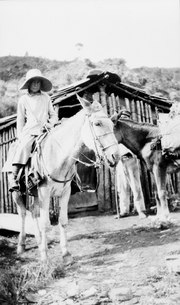
Mary Agnes Chase
1869–1963. Standard IPNI form: Chase
Mary Agnes Chase, née Merrill, was an American botanist who worked at the U.S. Department of Agriculture and the Smithsonian Institution. She is considered one of the world's outstanding agrostologists and is known for her work on the study of grasses, and also for her work as a suffragist. Chase was born in Iroquois County, Illinois and held no formal education beyond grammar school. That aside, she made significant contributions to the field of botany, authored over 70 scientific publications, and was conferred with an honorary doctorate in science from the University of Illinois. She specialized in the study of grasses and conducted extensive field work in North- as well as and South America. Her Smithsonian Field Books collection from 1897 to 1959 is archived in the Smithsonian Institution Archives.
In 1901, Chase became a botanical assistant at the Field Museum of Natural History under Charles Frederick Millspaugh, where her work was featured in two museum publications: Plantae Utowanae (1900) and Plantae Yucatanae (1904). Two years later, Chase joined the U.S. Department of Agriculture (USDA) as a botanical illustrator and eventually became a scientific assistant in systematic agrostology (1907), assistant botanist (1923), and associate botanist (1925), all under Albert Spear Hitchcock. Chase worked with Hitchcock for almost twenty years, collaborating closely and also publishing, for instance The North American Species of Panicum (1910).
Following Hitchcock's death in 1936, Chase succeeded him to become senior botanist in charge of systematic agrostology and custodian of the Section of Grasses, Division of Plants at the United States National Museum (USNM). Chase retired from the USDA in 1939, but continued her work as custodian of the USNM grass herbarium until her death in 1963. She was an Honorary Fellow of the Smithsonian Institution (1959) and Fellow of the Linnean Society of London (1961). Agnesia is named in her honour (a monotypic genus of herbaceous South American bamboo in the grass family).
Chase experienced discrimination based on her gender in the scientific field, for example, being excluded from expeditions to Panama in 1911 and 1912 because the expedition's benefactors feared the presence of women researchers would distract men. During World War I, Chase marched with Alice Paul and was jailed several times for her activities. In 1918, she was arrested at the Silent Sentinels rally picketing the White House; she refused bail and was held for 10 days, where she instigated a hunger-strike and was force-fed. The USDA accused her of "conduct unbecoming a government employee," but Hitchcock helped her keep her job. Chase was also an active member of the National Association for the Advancement of Colored People (NAACP).
See also: Distinguished authors of previous months.Species of the month
Humpback Anglerfish or Johnson's Blackdevil

Some facts on this fish:
Length: Males: up to 3 cm. Females: up to 20 cm.
Number of teeth: Upper jaw: 29–178. Lower jaw: 32–142.
Diet: Crustaceans.
Range: Tropical to temperate parts of all oceans; depth from 700 to 2000 meters.
First described: By the British zoologist Albert Günther in 1864.
Melanocetus johnsonii has a mouth full of teeth and a lantern on its nose. The female's snout ends in a "fishing rod"-a glowing blob of light that contains millions of light-producing bacteria. It acts as a lure to attract prey. The males are tiny, lack teeth and have extremely large nostrils and a powerful sense of smell to aid in locating females. They can detect a special pheromone that the female releases. This deep-water fish is capable of catching and swallowing prey larger than itself. Belongs to the genus Melanocetus or Black Seadevils, which contains 5 species, and forms a separate family-Melanocetidae.
(Archived from Template:Species of the week)
Source: Species-2023-04
Wikispecies in other languages
- Aceh
- Afrikaans
- Aragonés
- Ænglisc
- अंगिका
- العربية
- الدارجة
- অসমীয়া
- Asturianu
- Azərbaycanca
- Basa Bali
- Boarisch
- Беларуская
- Български
- بلوچی
- বাংলা
- Brezhoneg
- Bosanski
- Català
- Нохчийн
- Čeština
- Cymraeg
- Dansk
- Deutsch
- Zazaki
- Ελληνικά
- English
- Simple English
- Esperanto
- Español
- Eesti
- Euskara
- فارسی
- Suomi
- Føroyskt
- Français
- Nordfriisk
- Galego
- Ἑλληνική
- Alemannisch
- עברית
- हिन्दी
- Hrvatski
- Magyar
- Հայերեն
- Interlingua
- Bahasa Indonesia
- Íslenska
- Italiano
- 日本語
- Basa Jawa
- ქართული
- қазақша
- 한국어
- Ripoarisch/Kölsch
- Кыргызча
- Македонски
- молдовеняскэ
- मराठी
- Bahasa Melayu
- Mirandés
- မြန်မာဘာသာ
- Norsk bokmål
- Neadersassisk
- नेपाली
- Nederlands
- Nynorsk
- Occitan
- ଓଡ଼ିଆ
- Polski
- Português
- Runa Simi
- Română
- Русский
- ᱥᱟᱱᱛᱟᱲᱤ
- Sardu
- Sicilianu
- Scots
- සිංහල
- Slovenčina
- Slovenščina
- Српски
- Srpski
- Sunda
- Svenska
- ꠍꠤꠟꠐꠤ
- Ślōnski
- தமிழ்
- Тоҷикӣ
- ไทย
- Tagalog
- Türkçe
- ئۇيغۇرچە
- Українська
- Veneto
- Tiếng Việt
- Volapük
- ייִדיש
- 粵語
- 简体中文
- 繁體中文
Wikispecies is hosted by the non-profit Wikimedia Foundation, along with several other multilingual and free-content projects:
-
Meta-Wiki
Coordination of all
Wikimedia projects -
Wikipedia
The free encyclopedia -
Commons
Free media repository -
Wikibooks
Free textbooks and manuals -
Wikiquote
Free collection of quotations -
Wiktionary
Free dictionary and thesaurus -
Wikisource
The free library -
Wikinews
Free content news source -
Wikiversity
Free learning resources -
Wikidata
Free knowledge base -
Wikifunctions
Free software functions -
Wikivoyage
Free travel guide -
MediaWiki
Free wiki software


